Heat · dry sauna, steam & infrared
Sauna tracker for Apple Watch: how long you stayed, the heat you entered, and an honest estimate.
Hormetic is a sauna app for Apple Watch and iPhone. It logs dry sauna, steam and infrared sessions as Apple Health workouts. Each gets an Estimated score from the temperature you enter, how long it ran and, when recorded, how far your heart rate rose above resting. It never suggests a session length.
Requires iPhone running iOS 18.6 or later, and Apple Watch running watchOS 11.6 or later, which records your sessions and heart rate. Apple Watch Ultra adds automatic submersion detection and water-temperature sensing for cold plunges and soaks.

How it works
How do you track a sauna session?
Sessions are recorded on Apple Watch and reviewed on iPhone.
Before: pick the heat, enter the temperature
On Apple Watch, tap Heat, then Dry, Infrared or Steam. Set the ambient temperature with the Digital Crown: the value on the room's gauge, or your best estimate if a steam room has none. Recording begins after a 3-second countdown you can cancel.
During: what's measured and what isn't
Elapsed time is measured. When Apple Watch records heart rate, Hormetic compares it with your resting rate from Apple Health, or 70 bpm if none is available. Humidity isn't measured; the heat type you picked stands in for it.
After: see what fed the estimate
iPhone shows Peak score · Estimated and Time in Zone 3 · Estimated. A heart-rate chart marks when Zone 2 and Zone 3 · Estimated began. “What fed this estimate” lists each input as measured, entered or not recorded, plus the algorithm version when the session saved one.
In the app
Real screens from Hormetic 1.7.
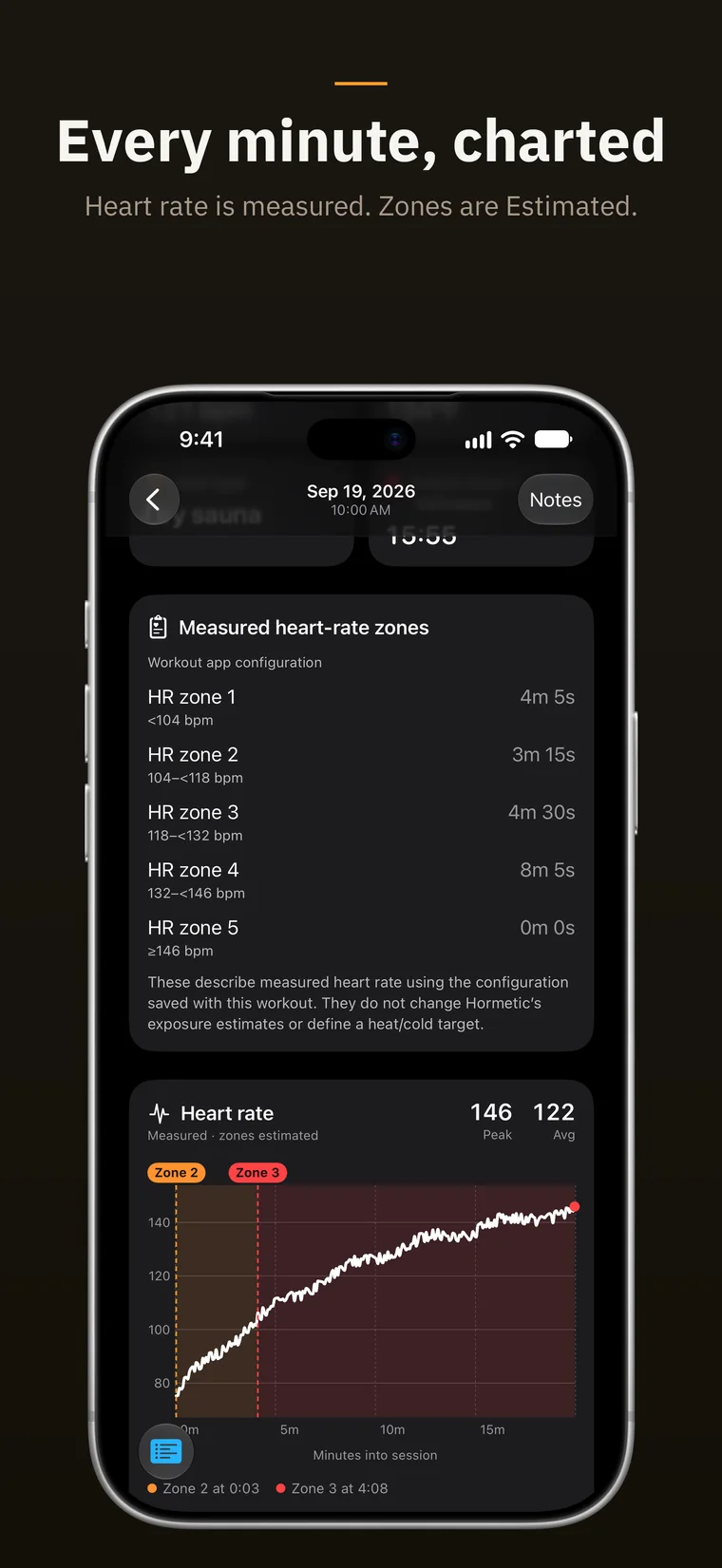
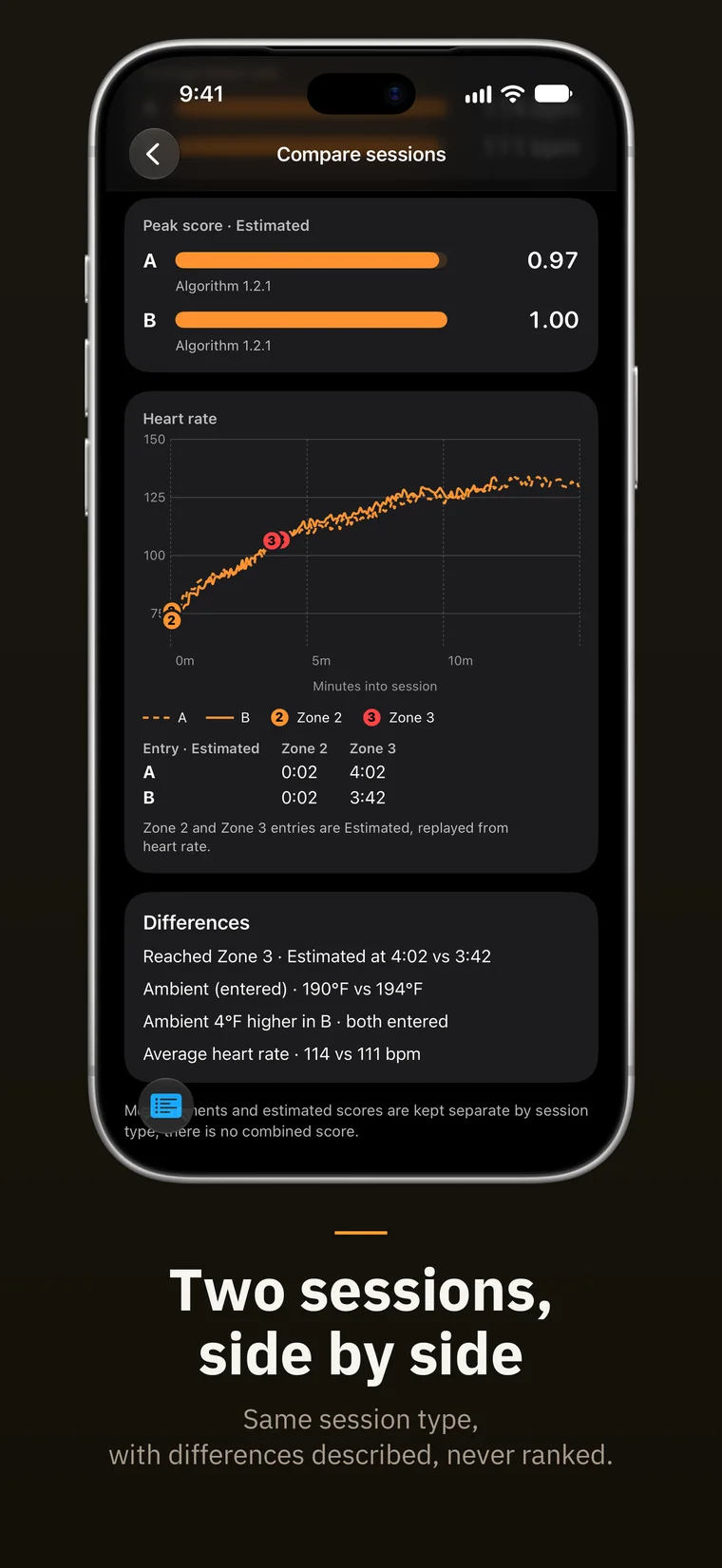
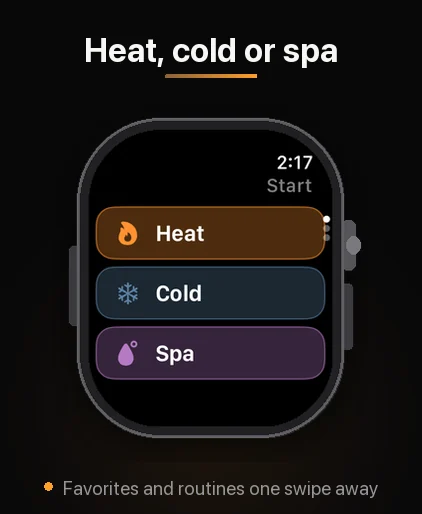
The zones
What do Zone 1, 2 and 3 mean in a sauna?
The score combines heart rate elevation, the temperature you enter, and elapsed time into a single 0.0–1.0 estimate of thermal load. Zone 3 starts at an Estimated score of 0.75. On iOS 27, iPhone also shows Apple's heart-rate zones 1–5. Those are measured and separate, and they don't change this estimate.
Warming Up
Score 0.00 to under 0.40 · Estimated. Below the model's thermal-load threshold.
Approaching
Score 0.40 to under 0.75 · Estimated. iPhone calls it Approaching Hormetic Range. That's a name, not a target.
Hormetic Zone
Score 0.75 or higher · Estimated. It isn't a finish line or a state your body entered, and it can arrive before minute 2.
Dry sauna is the calibrated profile. Steam and infrared use an assumed-humidity calibration (no live humidity sensor), so the thermal part of those estimates is lower-confidence. Cold plunges and hot tubs are scored on their own scales: see cold plunge tracking and hot tub tracking.
How often
How often should you sauna?
There's no established best frequency. The best-known data come from Finland's KIHD study, a long-running study of heart disease risk. It grouped men by once, 2–3, or 4–7 sauna sessions a week. The study had no group above 7 a week, so it says nothing about more frequent use.
Hormetic doesn't recommend a frequency. What those groups showed, and the limits of that evidence, are in the research section below.
How long
How long should you stay in a sauna?
Research hasn't pinned down a best length. A review of 40 dry-sauna studies concluded that more research is needed on the best frequency and duration. It describes traditional Finnish sauna as short exposures of about 5 to 20 minutes at 176–212 °F (80–100 °C). That describes a habit; it isn't a recommendation.
Hormetic won't pick a number either. It keeps the record: how long the session ran, any heart rate Apple Watch recorded, and your Estimated time in Zone 3.
20 minutes
Is 20 minutes in the sauna enough?
There's no established “enough.” The Finnish KIHD study asked about session length once, at the start. It's unclear whether a “session” meant one round or a whole visit, so Hormetic doesn't match your session lengths to any study group.
In the score, minute 20 isn't special. Time adds nothing for the first 2 minutes and nothing more after minute 5.
The research
Does sauna actually do anything?
Possibly, but less is settled than you'll read. The evidence on long-term outcomes, such as cardiovascular deaths, is observational, so it can't show that sauna caused anything. Randomized trials exist, but they are small.
Cardiovascular deaths: one Finnish cohort, two reports
KIHD followed 2,315 men aged 42–60 for a median 20.7 years. Of the 201 who went 4–7 times a week, 12.0% died of cardiovascular disease, against 22.3% of the 601 who went once a week. The link held after adjusting for other risk factors. A 2018 report on 1,688 men and women found a lower rate of cardiovascular death among men going 4–7 times a week. That rested on only 8 such deaths. Among women, the paper's table shows no clear difference for 2–3 times a week. With no cardiovascular deaths among the 73 women in the 4–7 group, that result couldn't be estimated. The authors still concluded the association held for men and women combined. Association, not causation.
Randomized trials: real, but small
One 8-week randomized trial enrolled 47 sedentary adults, mostly women, each with at least one cardiovascular risk factor. The 15 who added a 15-minute sauna after exercise three times a week were compared with 16 who only exercised. Systolic blood pressure fell 8.0 mmHg more in the sauna group (95% CI 1.4 to 14.6). Hormetic doesn't track or manage blood pressure.
Where the evidence runs thin
A systematic review covered 40 studies of regular dry-sauna use, with 3,855 participants in total. Of those studies, 25 looked at infrared and 11 at traditional Finnish sauna; studies mainly of steam rooms were left out. Most reported beneficial effects, but only 13 were randomized, and most had fewer than 40 people. A separate study followed 40 pair-matched female team-sport athletes for 6 weeks. Infrared sauna after training (10 minutes at 122 °F / 50 °C, three times a week) added no detectable muscle growth. One loaded-jump power test improved, which the authors described as a possible benefit.
The big cohorts are observational, Finnish and mostly male, and recorded sauna habits once. The KIHD authors say their findings can't be applied directly to steam rooms. Infrared research comes mostly from small trials, many in people with heart failure.
Using it safely
Sauna safety: what Hormetic records, and what you enter
Nothing needs to go in the hot room. The temperature is a value you enter, never a reading from the room. Heart rate is used when Apple Watch recorded it. With none recorded, the entered temperature and elapsed time still produce an Estimated score, which can reach Zone 3. Apple lists wearing a Watch in a sauna or steam room among things to avoid.
Apple designs iPhone and most Apple Watch models to work best in 32–95 °F (0–35 °C) ambient air, and a sauna runs far hotter. Heat exposure carries cardiovascular and dehydration risk. Check with a physician first if you have a heart condition, are pregnant, or take medication that affects heat tolerance.
Three safeguards end a forgotten session, and none is a target. When recorded heart rate settles back toward resting, the Watch asks “Still in your session?” With no reply within 90 seconds, the session ends. A 3-hour backstop ends a paused session when you next resume it or open Hormetic on your Watch. An active-time cap covers everything else.
Hormetic is for wellness tracking. It is a tracking tool, not a medical device, and doesn’t diagnose, treat, or prevent anything.
Questions, answered plainly
Frequently asked
Is Hormetic a sauna timer?
It records how long each session runs, but it isn't a countdown timer. Apart from the 3-second countdown before recording, Hormetic only counts up and never suggests how long to stay. Any minutes goal in Adapt is one you set yourself.
Why can Zone 3 · Estimated appear in the first 2 minutes?
Zone 3 starts at an Estimated score of 0.75. A high heart rate and a hot entered temperature can lift the score there on their own, before elapsed time adds anything. Zone 3 · Estimated describes modeled load, not session length.
Are steam rooms and infrared saunas scored like a dry sauna?
Same zones and cutoffs; only the temperature scale changes. The temperature part of the score rises across a set range, then stops: 149–194 °F (65–90 °C) for dry, 118–149 °F (48–65 °C) for infrared, and 104–122 °F (40–50 °C) for steam. The Watch's dry dial starts at 158 °F (70 °C). A hotter entered temperature raises the Estimated score, which describes modeled load, not a benefit. Steam and infrared are lower confidence because humidity is assumed.
Do sauna sessions show up in Apple Health?
Yes, as workouts. From Hormetic 1.7, each new session is saved with its name (Dry Sauna, Steam Room or Infrared Sauna), which Apple Fitness shows as its title. The workout type in Apple Health is still Other, and older sessions keep “Other”.
Do I need an Apple Watch to use Hormetic?
Yes. Apple Watch running watchOS 11.6 or later records each session and its heart rate; iPhone (iOS 18.6 or later) shows the history and Estimated scores. For a sauna, you always enter the temperature. On Apple Watch Ultra, cold plunges and soaks also detect the water and read its temperature. On other Apple Watch models, you enter it.
Keep reading
Each one on its own scale.
Try it · $2.99 one-time
Track your first sauna session.
$2.99, one-time — no subscription, no in-app purchase, no account. Requires iPhone running iOS 18.6 or later, and Apple Watch running watchOS 11.6 or later, which records your sessions and heart rate. See how heat, cold and spa fit together.