Cold plunge & ice bath · Apple Watch & iPhone
A cold plunge tracker for Apple Watch that won’t tell you to stay in longer.
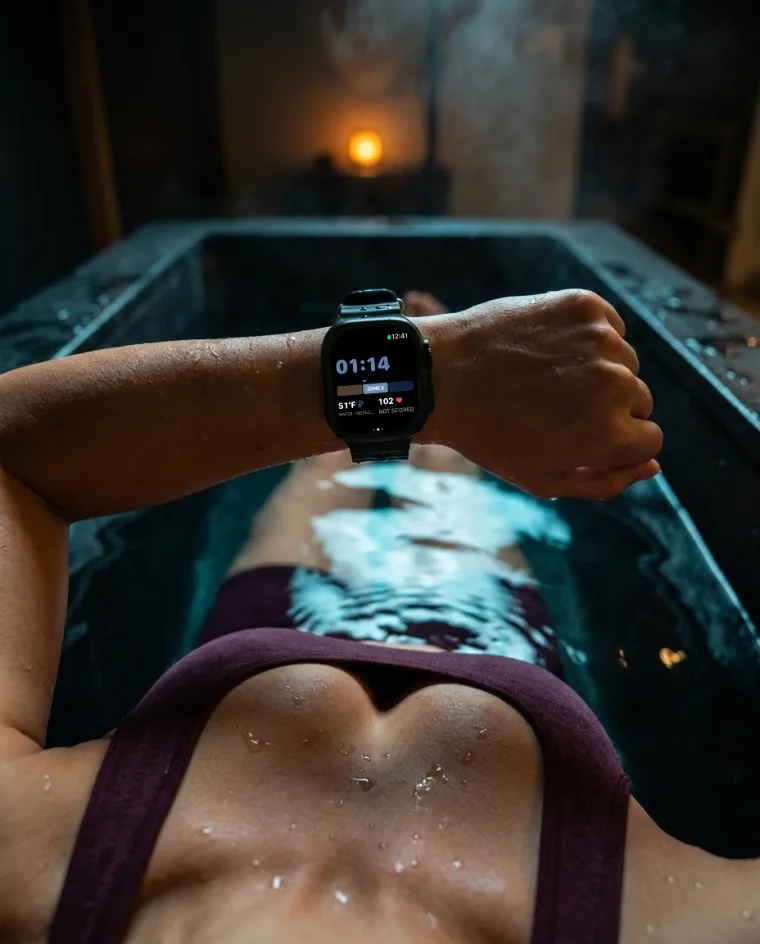
Tap Start, then get in. The ice bath timer counts up, never down, and never suggests how long to stay. Each plunge saves to Apple Health as a workout. In Hormetic you see where the water temperature came from (measured, entered, or none) and an Estimated cold score built only for cold.
Requires iPhone running iOS 18.6 or later, and Apple Watch running watchOS 11.6 or later, which records your sessions and heart rate. Apple Watch Ultra adds automatic submersion detection and water-temperature sensing for cold plunges and soaks.
How it works
How do you track a cold plunge on Apple Watch?
What happens after Start depends on your Watch. Read the safety section before a first plunge.
Before: tap Cold, then Start
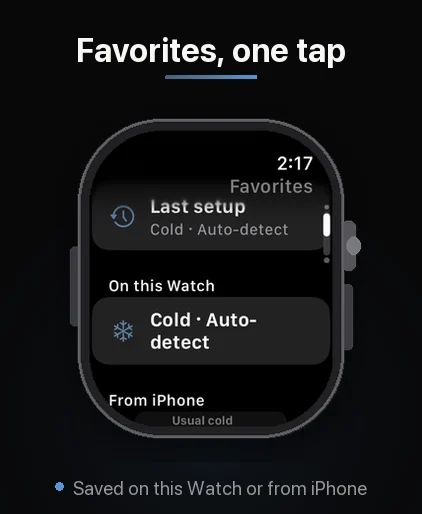
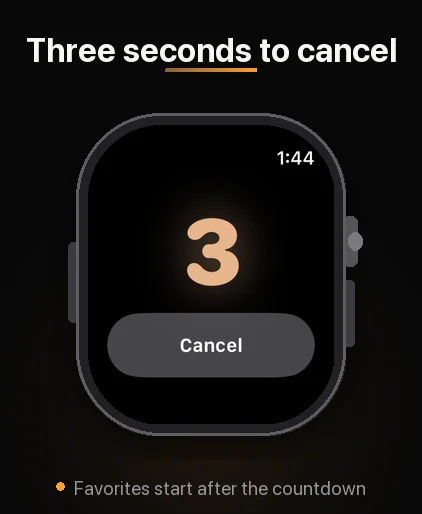
On Apple Watch Ultra, the start screen reads Auto-detect. After the 3-second countdown, Water Lock turns on and the timer begins when water is detected. On other Apple Watch models, enter the water temperature or tap “I don’t have a gauge”; a plain timer starts after the countdown.
During: water time on Ultra, a timer on other models
On Apple Watch Ultra, the clock holds at 00:00 until water is detected, then counts time in the water. If your wrist comes out and you answer Yes to “Still plunging?”, that gap counts too. On other Apple Watch models, the timer runs until you tap End. Heart rate is recorded, not scored.
After: iPhone shows its work
The plunge saves to Apple Health, and new sessions appear as Cold Plunge in Apple Fitness. iPhone shows the water temperature and its source, the peak Cold Zone and cold score (both Estimated), and the hazard stage reached.
In the app
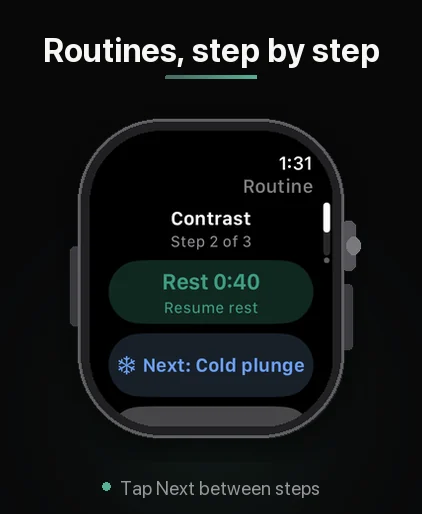
Real screens from Hormetic 1.7.
The cold zones
Did that plunge even do anything? What an Estimated cold zone can and can’t say
Hormetic can’t tell you that. It gives you an Estimated cold score from 0.00 to 1.00: a modeled load, not an effect measured in your body. Water temperature carries 65% of it: nothing at 59 °F / 15 °C or warmer, the most at 41 °F / 5 °C or colder. Time carries 35%: nothing for the first 20 seconds, and no further rise after 2.5 minutes, a modeling cap, not a target.
Entering
Estimated score below 0.40, in warm sand: a brief or mild plunge.
Moderate Cold
Estimated score from 0.40 to under 0.75, in cooling slate.
Significant Cold
Estimated score of 0.75 or more, which needs a measured or entered water temperature. Calm deep blue, not red: a dose, not an alarm or a goal.
With no gauge, the Estimated score uses time alone, is marked lower confidence, and stops at 0.70. Only the 59 °F line comes from research; the other numbers, including zone cuts borrowed from the heat model, are provisional. The sauna and hot tub guides cover their own zones.
How long
How long should you cold plunge?
No study has settled a best length for an everyday plunge, and Hormetic doesn’t pick one. Research maps when the risks arrive, with timing that shifts with water temperature (Tipton 2017). Cold shock comes in roughly the first 3 minutes; grip and coordination start to fail from about 3 minutes. Hypothermia in adults usually takes at least 30 minutes, even in ice-cold water: a hazard boundary, not a safe window.
A typical plunge stays in the first two stages, where the risks are breathing and coordination. iPhone names the stage each plunge reached and scores nothing for it: a hazard clock, not a benefit meter.
How cold
How cold should a cold plunge be?
A 2017 review calls water below 59 °F / 15 °C a reasonable definition of cold, though there’s no strict one. Cold shock has been reported in water as warm as 77 °F / 25 °C, and the breathing response already peaks at 59–50 °F / 15–10 °C. Our reading: colder water doesn’t make the first minute any safer. Hormetic’s temperature term stops adding score below 41 °F / 5 °C, a community convention, not a research threshold or advice.
After the gym
Is a cold plunge after lifting bad?
Not across the board, but timing may matter if you lift to build muscle. In a 12-week strength trial of 21 physically active men, one group took 10 minutes of cold-water immersion after each session (Roberts 2015). It gained less strength and muscle than a group doing active recovery.
A 2024 meta-analysis of eight small, fair-to-poor-quality studies, all in young adults and mostly men, leans the same way on muscle growth (Piñero 2024). It did not pool strength, and its uncertainty range still includes no effect. Hormetic’s in-app guidance: if you lift to build muscle, separate the plunge from strength work by several hours. That’s a cautious inference; the studies tested cold right after lifting.
The research, with its limits
What cold-water studies measured, and what they didn’t
Hazards first. The rest are short-term studies lasting weeks, often small.
The first minutes carry the risk
The cold-shock gasp can override conscious breathing control and may be a precursor to drowning. Cold submersion has also produced irregular heartbeats in a high share of healthy volunteers, especially on releasing a held breath. One review proposes that cold shock and the diving reflex, firing together, explain them and may explain some deaths in vulnerable people. The irregular heartbeats were measured; the link to deaths is a hypothesis.
Soreness, not adaptation
Across 14 studies, cold-water immersion moderately reduced soreness for up to four days after strenuous exercise; its effect on muscle function was less clear. Taken right after strength training, it has been linked to smaller muscle gains, as the lifting answer above explains. Less sore is not the same as adapting more.
We know of no long-term study that has grouped people by how often they cold plunge and followed their health. The research covers short-term responses and training studies of weeks to months. Hormetic records what you did and estimates the load. It is a tracking tool, not a medical device, and doesn’t diagnose, treat, or prevent anything.
Plunge safely
Is a cold plunge safe? The risks, plainly
Cold-water immersion carries real risk, so read this before you plunge. Sudden immersion triggers the cold-shock response: an involuntary gasp, then rapid breathing you can’t fully control for the first 30–90 seconds. Breathing in water during that gasp can lead to drowning long before deep cold matters. Don’t hyperventilate or hold your breath beforehand, enter gradually, and keep your airway clear of the water.
Don’t plunge alone, keep sessions short, and rewarm gradually afterward. If you have a heart condition or high blood pressure, or are pregnant, talk to a doctor first. Hormetic’s Estimated cold score doesn’t make cold water safe, and the app has no in-water alert telling you when to get out. A cited safety card tops every cold session’s detail page on iPhone, and the full guide is in the Learn tab.
Water and your Watch: Apple says Apple Watch Series 2 and later can be used for shallow-water activities like swimming in a pool or ocean. Hormetic reads that as covering a cold plunge. Apple warns that soap and soapy water can affect the water seals. Rinse with warm fresh water after a treated pool or tub, then dry thoroughly.
Questions, answered plainly
Frequently asked
Does Apple Watch measure water temperature?
Some models do. Apple’s Depth app shows water temperature on Apple Watch Ultra and Series 10 and later. In Hormetic 1.7, automatic water-temperature reading is supported on Apple Watch Ultra, labeled measured. On other Apple Watch models, you enter the temperature, labeled entered, or choose “I don’t have a gauge.” More in our explainer.
Can I use Hormetic as an ice bath timer?
Yes. It counts up, never down, and sets no target duration. On Apple Watch Ultra, it counts time in the water plus any wrist-out gap you confirm. On other Apple Watch models, it runs from the end of the 3-second countdown until you tap End, minus any pause. An ice bath is logged as a cold plunge.
What does Hormetic do when my wrist comes out of the plunge?
On Apple Watch Ultra, the clock stops when your wrist leaves the water. After about 7 seconds out, the Watch asks “Still plunging?” Press and hold the Digital Crown to unlock, then answer Yes to credit the gap back. Left unanswered for 75 seconds, the plunge ends and saves. On other Apple Watch models, the timer runs until you tap End, and a forgotten session closes after 69 minutes.
Why doesn’t Hormetic’s Estimated cold score use heart rate?
Cold water pulls heart rate both ways: cold shock speeds it up, while the diving reflex (strongest when your face goes under) can slow it. Narrowed skin blood vessels also make wrist readings less reliable. So Hormetic records heart rate for display and labels it not scored.
Does Hormetic count a sauna then a cold plunge as one session?
No. Hormetic logs and scores each on its own, and each routine step needs its own Start. If a plunge follows a sauna or hot tub soak that ended within 90 minutes, iPhone adds a contrast note, not a combined score. Contrast studies alternated hot and cold water, and a 2013 review rated all 18 of its trials at high risk of bias. Applying them to a sauna then a plunge is an extrapolation.
Keep reading
Each one on its own scale.
$2.99 · one-time
Track your first plunge, and see which numbers were measured.
$2.99, once: no subscription, no in-app purchases, no account. Requires iPhone running iOS 18.6 or later, and Apple Watch running watchOS 11.6 or later, which records your sessions and heart rate. Apple Watch Ultra adds automatic submersion detection and water-temperature sensing for cold plunges and soaks. A wellness tracker, not a medical device. See how heat, cold and spa fit together.